The Psychology Behind Google 360 Virtual Tours — Why They Convert Customers Better Than Any Other Tool
🚀 The Real Reason Virtual Tours Work — It Has Nothing to Do With Technology
Here's something most people get wrong about Google 360 Virtual Tours.
They think the value is in the technology. The 360° camera. The stitched panoramas. The way it loads on Google Maps without an app. And yes all of that matters. But none of it is the actual reason a virtual tour turns a browsing stranger into a paying customer.
The real reason is psychology.
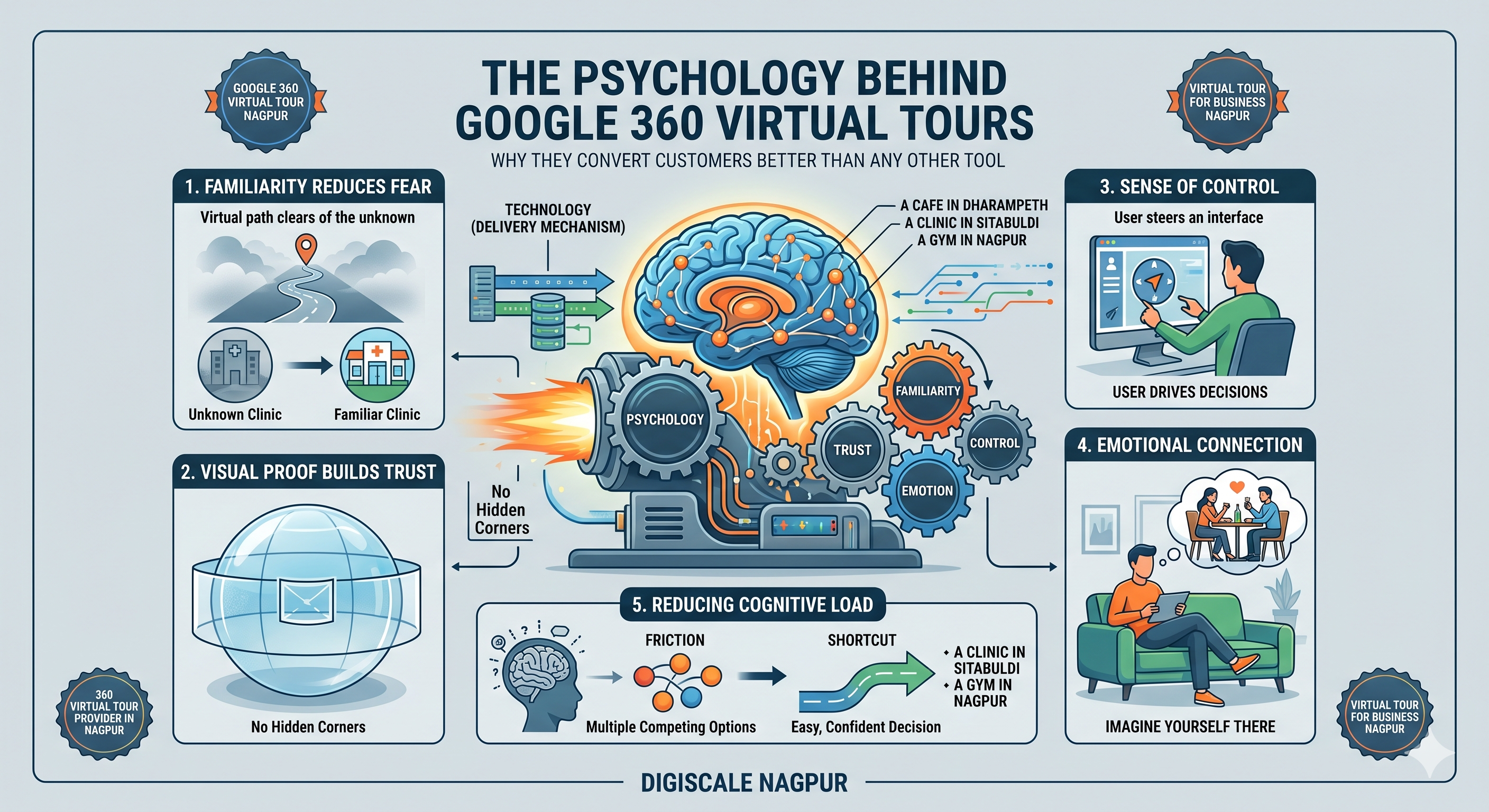
The way a 360 virtual tour is experienced in someone's brain — the emotions it triggers, the doubts it removes, the decisions it influences — that's what drives conversions. The technology is just the delivery mechanism. The psychology is the engine.
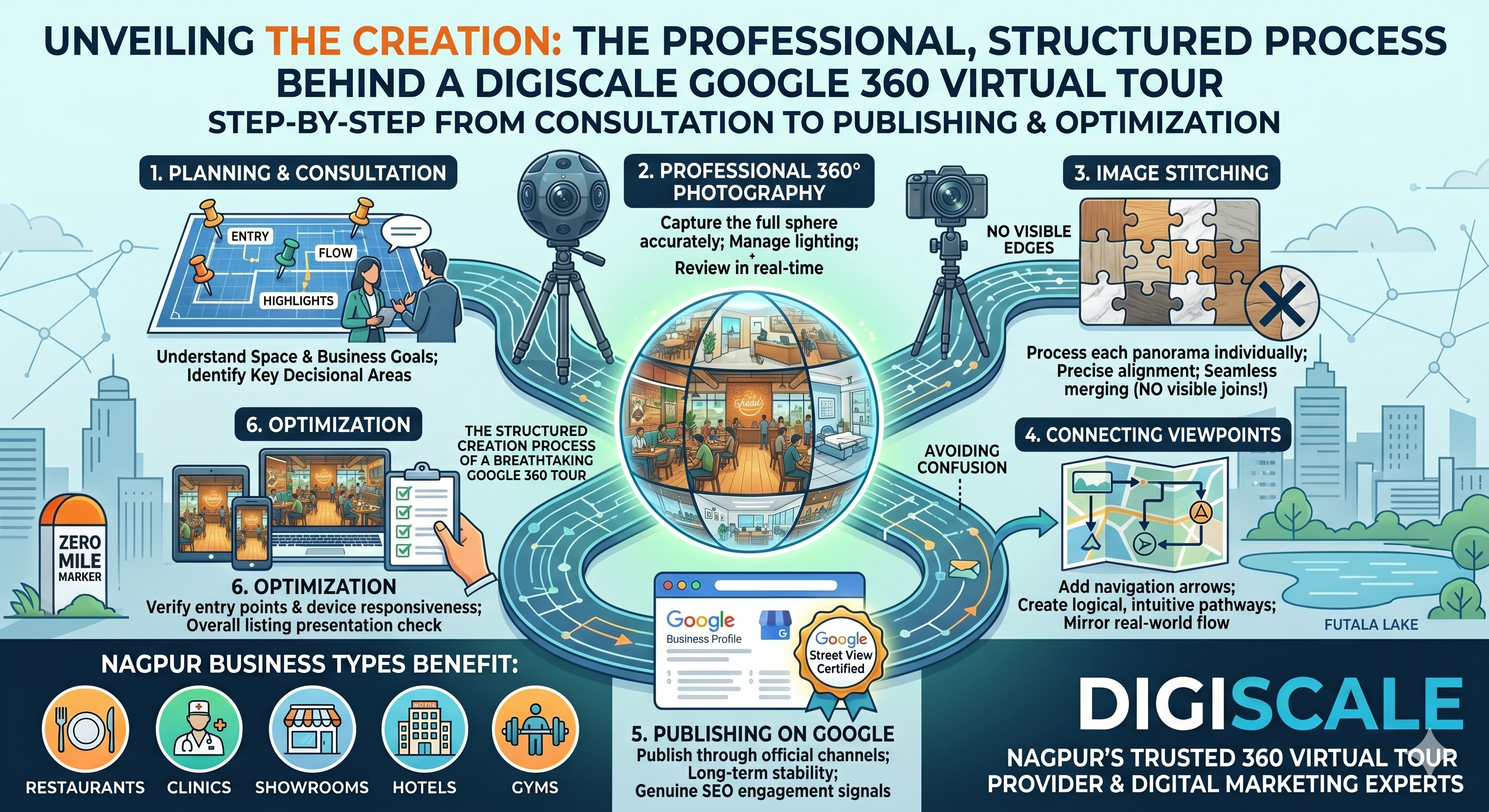
At Digiscale, as a dedicated 360 virtual tour provider in Nagpur, we've seen this play out across dozens of businesses restaurants, clinics, gyms, showrooms, hotels. The pattern is consistent every time: a well-made virtual tour changes how customers feel about a business before they've even visited. And that feeling is what makes them choose you.
This blog breaks down exactly what's happening in the mind of your customer when they interact with a Google 360 Virtual Tour and why understanding this is more valuable than any spec sheet about camera resolution.
🧠 1. Familiarity Reduces Fear - And Fear Is the #1 Reason People Don't Visit
This is the most important psychological principle behind virtual tours, and it's rooted in something very basic about human behaviour.
We avoid the unfamiliar. Not because we're cowardly but because our brains are wired to conserve energy and minimize risk. Walking into a completely unknown environment — a new clinic, an unfamiliar restaurant, a showroom you've never seen triggers a mild but real sense of anxiety. Will it be what I expected? Will I feel comfortable? What if I wasted the trip?
This uncertainty is enough to make people hesitate. To delay. To keep scrolling and look at other options.
A Google 360 Virtual Tour eliminates that uncertainty completely.
When someone virtually walks through your space sees your reception area, your seating arrangement, your treatment rooms, your product displays that space becomes familiar to them. Their brain has already processed it. They know what to expect. The unknown becomes known.
And familiar places feel safe. Safe places feel worth visiting.
This is why businesses in Nagpur that have invested in a 360 virtual tour consistently see more walk-ins from people who say "I saw your place online before coming" because those people weren't strangers walking into the unknown. They were visitors returning to somewhere they'd already been, at least virtually.
For any business where the environment matters to the customer's decision — a restaurant, a clinic, a gym, a hotel removing that fear of the unknown is worth more than any discount or promotion you could offer.
🤝 2. Visual Proof Builds the Kind of Trust That Words Never Can
We live in a world saturated with marketing claims. "Best in Nagpur." "Premium quality." "Hygienic and professional." "World-class experience."
Customers have heard all of it. And they've been disappointed enough times that they've learned not to believe it at least not without evidence.
This is the credibility crisis facing every business today. You can write the most compelling description of your space, post the most polished static photos, collect glowing testimonials — and customers will still carry a layer of scepticism. Because all of those things can be curated, edited, and staged.
A 360 virtual tour is different. It shows everything.
There are no hidden corners. No strategically cropped images. No flattering angles that hide an untidy section. When customers can freely explore your space in all directions rotating their view, moving from room to room, looking up, looking down they experience it as genuinely real. It's the closest thing to being physically present without actually being there.
And that completeness is what creates trust. Not because the tour says anything. But because it shows everything and lets customers draw their own conclusions. When they do, and when your space reflects the quality of your service the trust that forms is deep and genuine.
This is why Google 360 virtual tour services in Nagpur have become a credibility tool just as much as a marketing tool. A business that is willing to show its space completely is a business that is confident in what it has. Customers read that confidence instantly.
🎯 3. The Sense of Control Creates Confidence in Decision-Making
Think about what it's like to watch a video tour versus experiencing a 360 virtual tour.
In a video, you see what someone else decided to show you. You follow their camera. You look where they point. You experience the space on their terms, at their pace, in their sequence.
In a 360 virtual tour, you decide everything. You choose where to look. You choose where to move next. You pause where something catches your attention. You revisit a room if you want to look more carefully. You explore at your own pace, on your own terms.
This distinction matters enormously because autonomy is one of the most powerful psychological drivers of confidence.
When people feel in control of an experience, their trust in the information they're gathering increases significantly. The conclusions they reach feel like their own not something they were shown or told. And decisions made from a position of personal exploration carry much more conviction than decisions made from passive consumption.
In practical terms: a customer who has freely explored your restaurant through a Google 360 Virtual Tour has already chosen their favourite table. A patient who has walked through your clinic virtually has already decided the environment feels professional. They haven't been sold to. They've sold themselves.
That's the power of control in the customer journey and it's one of the core reasons a 360 virtual tour provider in Nagpur like Digiscale prioritizes the quality of navigation design in every tour we create. The freer and more intuitive the navigation, the more genuine the confidence customers build.
🔥 4. Emotional Connection They Imagine Themselves There Before They Arrive
Here's where virtual tours move from being informative to being genuinely powerful.
When someone spends 2–3 minutes exploring your space through a 360 virtual tour, something happens that goes beyond information gathering. They begin to imagine themselves there. They picture sitting at that corner table. They visualize themselves checking in at that hotel reception. They imagine their child studying in that classroom.
Psychologists call this mental simulation the brain's ability to run a preview of an experience before it happens. And research consistently shows that when people mentally simulate an experience, they develop an emotional attachment to it. The experience feels partially owned, even before it occurs.
This emotional connection is extraordinarily valuable in any purchase or visit decision. People don't just choose based on rational factors price, location, reviews. They choose based on how a place makes them feel. And a 360 virtual tour creates that feeling before the customer has even left their sofa.
A restaurant customer who has already imagined themselves dining in your space is not comparing you against competitors anymore. They've emotionally decided. The rational justification comes after the emotional choice is made.
This is why businesses that use Google 360 virtual tour services in Nagpur don't just see more visitors they see visitors who arrive more committed, more satisfied, and more likely to return. Because the expectation was set accurately, and the emotional investment was made before arrival.
A customer who has imagined themselves in your space is no longer a prospect. They're a guest who hasn't physically arrived yet.
🧩 5. Reducing Cognitive Load Easier to Process Means Faster to Decide
Every decision requires mental energy. Your brain has to gather information, evaluate options, weigh uncertainties, and reach a conclusion. The more effort this process requires, the more likely a person is to delay, hesitate, or abandon the decision entirely.
This is what psychologists call cognitive load the mental effort required to process information and make a choice. And high cognitive load is one of the biggest silent killers of customer conversions.
Think about what a customer has to do when your business only has a description and a few photos:
• Read the description and try to form a mental image of the space
• Look at the photos and wonder what the rest of the space looks like
• Try to gauge the size, the layout, the ambiance from limited information
• Fill in the blanks with their imagination which often defaults to doubt
• Wonder if it will match their expectations once they're actually there
All of that mental work creates friction. And friction reduces conversions.
A Google 360 Virtual Tour removes all of that friction in one move. The customer doesn't have to imagine anything they can see it. They don't have to wonder about the layout — they can navigate it. They don't have to fill in mental blanks there are no blanks left.
The result is a dramatically lower cognitive load. And when decisions are easy to make, people make them faster and with more confidence.
For any business where customers are comparing multiple options before deciding which is almost every business in Nagpur today a 360 virtual tour is a tool that shortcuts the comparison process in your favour. You've already answered every visual question. Your competitor hasn't.
📈 6. Social Proof Amplified - What Others See Shapes What You Believe
There's a sixth psychological principle that most articles on this topic miss entirely and it's one of the most powerful.
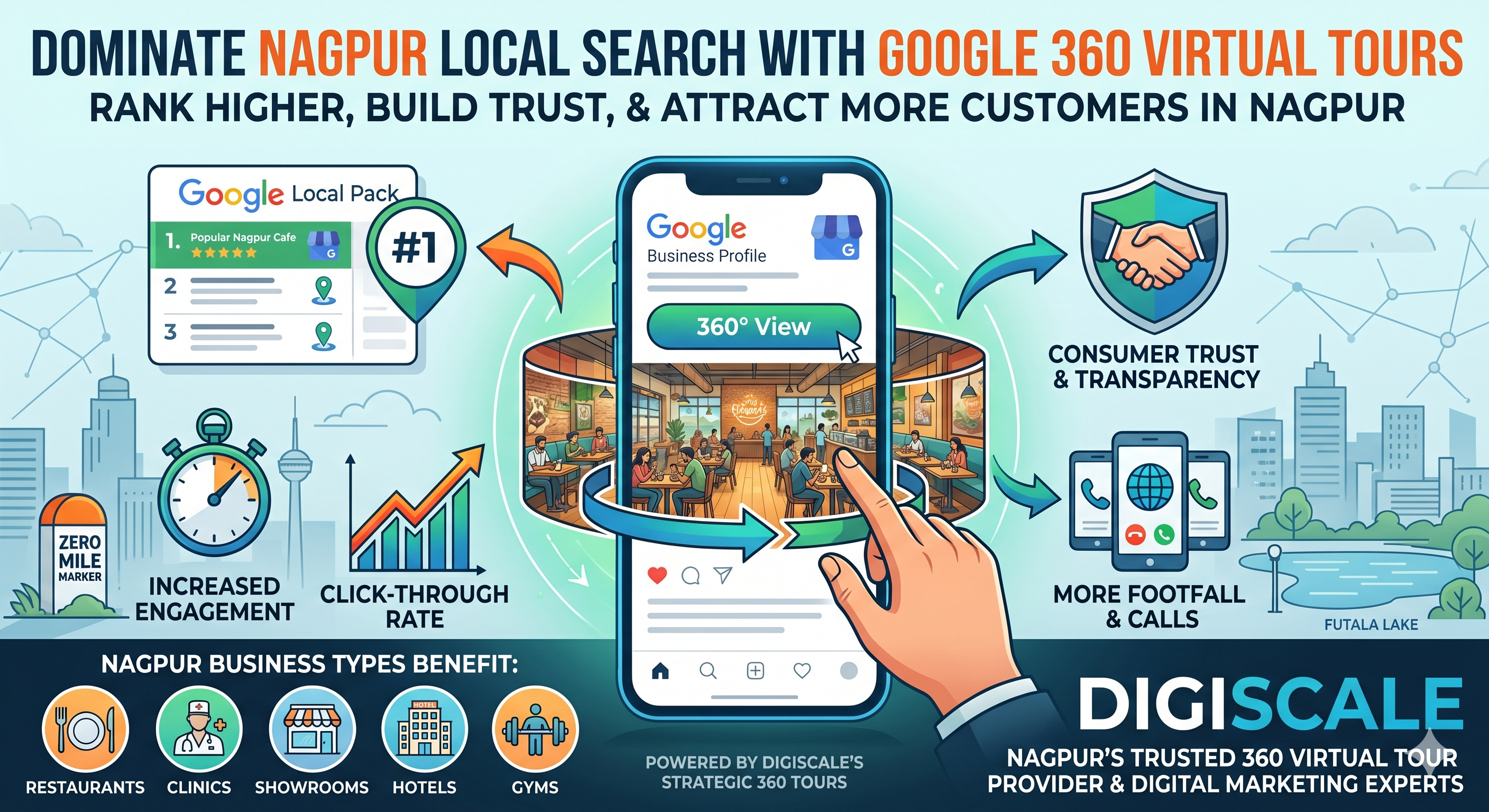
When a Google 360 Virtual Tour is embedded in your Google Business Profile and visible on Google Maps, it doesn't just influence the individual customer looking at it. It signals something to the broader market.
A business that has invested in a professional virtual tour is perceived subconsciously as a business that is established, confident, and worth visiting. The tour itself becomes a form of social proof. It communicates: "We're serious enough about our business to let you see every corner of it."
This perception shapes behaviour even before the tour is watched. The mere presence of a virtual tour on a Google listing increases click-through rates meaning more people engage with your listing simply because it signals quality.
In a city like Nagpur, where most businesses haven't yet adopted 360 virtual tours, this differentiation is significant. When a customer is scrolling through Google Maps comparing a restaurant that has a 360 tour against one that doesn't the psychological signal is clear. One business is confident enough to show everything. The other isn't.
Which one would you visit?
📌 7. Recency Bias - The Last Thing They See Is the First Thing They Remember
Here's a subtle but important psychological principle that makes 360 virtual tours particularly effective as a pre-visit tool.
Recency bias is the human tendency to give greater weight to the most recent information encountered when making a decision. When a customer's last touchpoint with your business before deciding to visit was exploring your 360 virtual tour your space is the most recent, most vivid impression in their mind.
They're not comparing a faded memory of a photo they saw three days ago. They're acting on a fresh, immersive experience they just had. Your space is current, clear, and present in their decision-making.
This is why timing matters. The 360 tour lives on your Google listing visible at exactly the moment when a potential customer is deciding whether to visit you. It's the right content, in the right format, at the right moment in the decision journey.
🗺️ How This Psychology Plays Out - Real Scenarios for Nagpur Businesses
A Restaurant in Dharampeth
A couple is deciding where to celebrate a birthday dinner. They search on Google, find three options. Two have photos. One yours has a 360 virtual tour. They explore it. They find the corner table by the window. They imagine sitting there. The ambiance feels right. They've already mentally chosen the table before making the reservation. They book. They arrive expecting exactly what they saw. They're satisfied. They leave a five-star review.
A Clinic in Sitabuldi
A patient is nervous about visiting a new specialist. They look up the clinic on Google Maps and find a 360 virtual tour. They walk through the waiting area virtually. It's clean, organized, and calm. The treatment rooms look professional. Their anxiety reduces. They feel like they've already been there. They book the appointment without the usual hesitation they'd have walking into an unknown medical environment.
A Gym in Nagpur
Someone is deciding between two gyms. Both have photos. But one has a 360 virtual tour. They explore the equipment floor, the cardio section, the changing rooms. They see the space is spacious and well-maintained. They've already started imagining their morning workout there. The other gym with just photos never gets that far into their mind. The decision is made before they've stepped through either door.
⚙️ Why the Quality of the Virtual Tour Determines the Psychological Impact
Everything described in this blog only works if the virtual tour is created correctly.
A poorly lit, poorly stitched, poorly navigated tour doesn't build familiarity it creates confusion. It doesn't build trust it raises doubts. It doesn't reduce cognitive load it increases it.
The psychological impact of a virtual tour is directly proportional to the quality of its execution. Which is why choosing the right Google 360 service provider in Nagpur matters as much as deciding to get a tour at all.
At Digiscale, every virtual tour we create is designed with the customer's psychological journey in mind not just the technical process. We think about where the tour starts and why. We design the navigation to guide customers through the most impactful areas of your space. We ensure the lighting, resolution, and stitching create an experience that feels genuinely real.
Because a tour that feels real creates the psychological effects described above. A tour that doesn't doesn't.
As Nagpur's trusted 360 virtual tour provider, we've delivered this for restaurants, clinics, hotels, gyms, showrooms, and educational institutes across the city. The businesses that see the strongest results are the ones that invested in quality and approached their virtual tour as a psychological tool, not just a photographic one.
📈 What the Data Says - Why This Psychology Is Already Proven
The psychological principles above aren't theory. They're backed by consistent patterns observed across Google Business Profile data:
• Listings with 360 virtual tours receive significantly more profile interactions than those without
• Users spend more time on listings with virtual tours a strong Google engagement signal
• Direction requests (people asking Google Maps to navigate to a business) are higher for listings with virtual tours
• Businesses with virtual tours are perceived as more trustworthy by first-time customers
• Conversion rates from Google Maps listings improve when virtual tours are present
These patterns are consistent across industries and geographies. And in Nagpur, where the adoption of 360 virtual tours is still relatively low, the businesses that invest now are building a psychological advantage that compounds over time.
📢 Final Thoughts Technology Delivers, Psychology Converts
The camera captures your space. The software stitches it together. Google's platform delivers it to your customers. All of that is the technology doing its job.
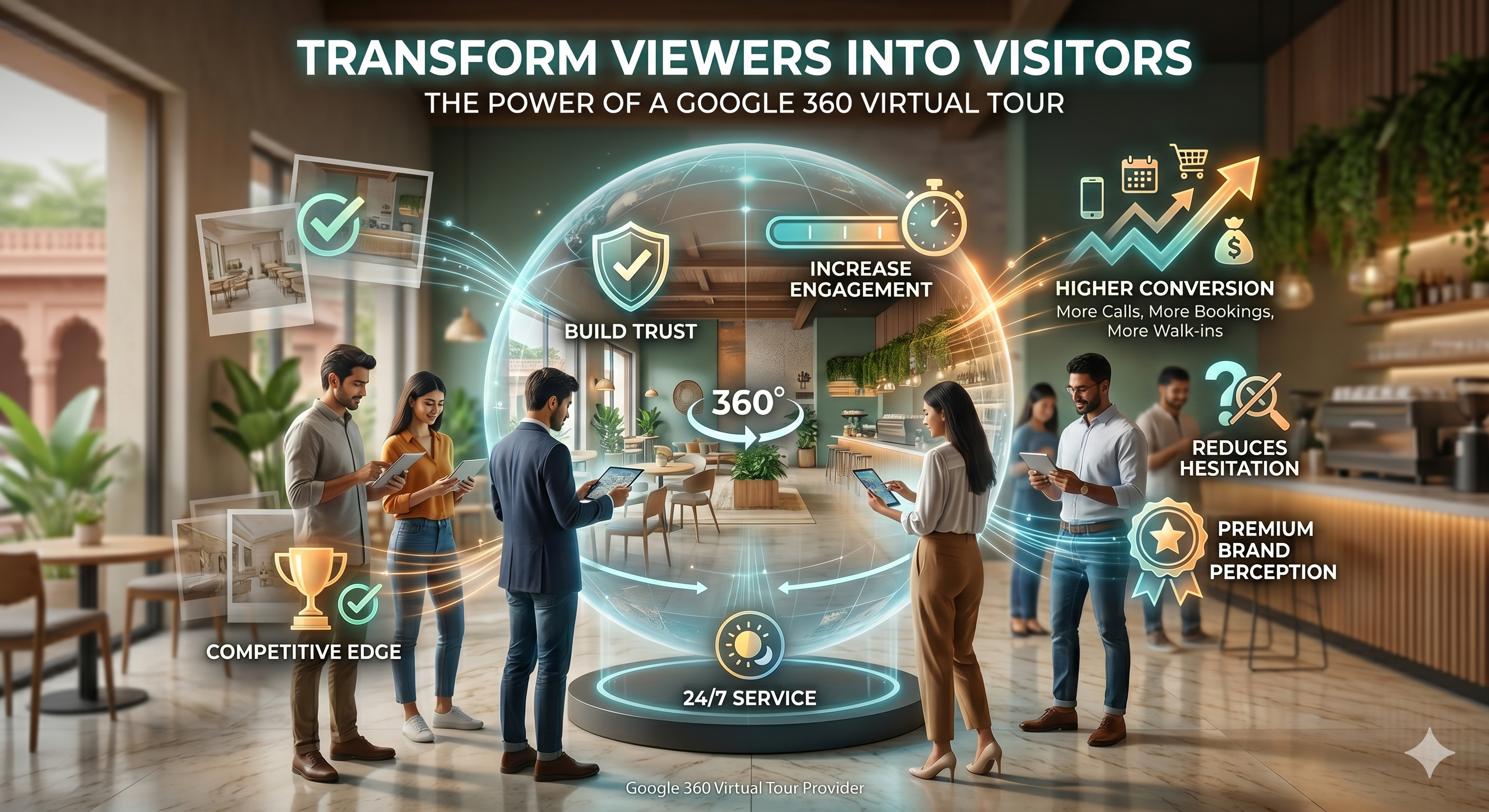
But what actually makes someone pick up the phone, type in directions, or book a table? That's the psychology. The familiarity that replaced their fear. The trust that formed when they saw everything. The confidence that grew from exploring on their own terms. The emotional connection they built before they ever walked through your door.
A Google 360 Virtual Tour works because it aligns perfectly with how human beings think, feel, and decide. And that alignment doesn't happen by accident it happens when the tour is created thoughtfully, with the customer's psychological journey in mind.
If your business in Nagpur serves customers whose decision is influenced by your environment and most do a 360 virtual tour isn't just a nice addition to your Google listing. It's one of the most psychologically effective conversion tools available to you right now.
Ready to give your customers the experience that turns browsers into visitors? Contact Digiscale Nagpur's #1 Google 360 virtual tour provider and let's build something that works.
Frequently Asked Questions
Why do 360 virtual tours convert better than regular photos?
Photos are passive customers look at what you've chosen to show them. A 360 virtual tour is interactive customers explore on their own terms. This sense of control and completeness creates trust and familiarity that static images simply cannot. The psychological engagement is fundamentally different.