How to Build a Digital Marketing Strategy for Your Indian Business From Scratch in 2026
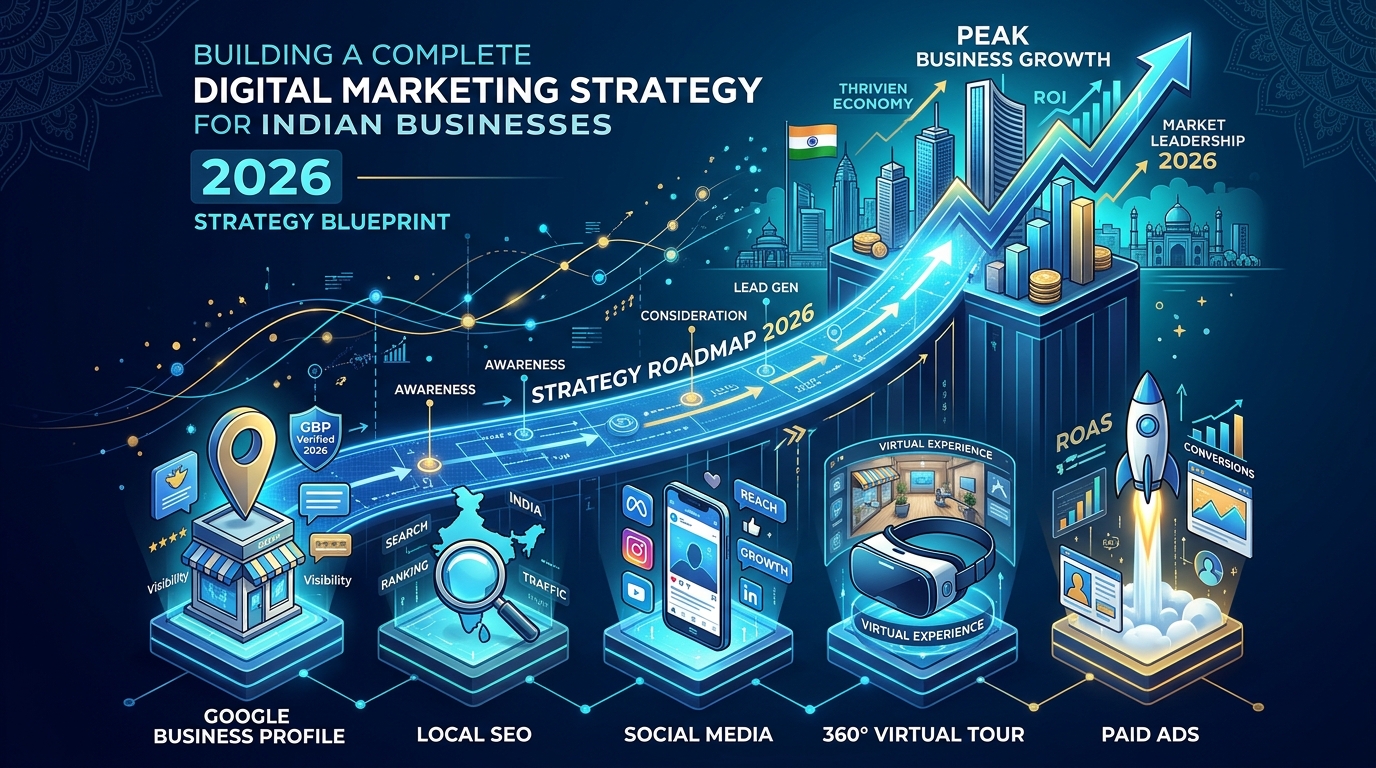
Most Indian business owners who try to build a digital marketing strategy end up with a list of channels they think they should be on rather than a connected system designed to produce specific business outcomes.
They create an Instagram account because everyone says you need one. They set up a Google Business Profile because someone told them to. They run a Facebook Boost because the app kept suggesting it. None of these individual actions are connected to each other or to a clear business goal.
This guide gives you a framework for building a proper digital marketing strategy for your Indian business from the beginning, one that connects every channel to every other channel and every action to a specific, measurable outcome.
Start With Business Goals, Not Marketing Channels
The most common mistake in building a digital marketing strategy is starting with the channels rather than the goals. Before you decide whether to be on Instagram or run Google Ads or invest in SEO, you need to answer one question with complete clarity.
What specifically do you want digital marketing to produce for your business in the next 12 months?
The more specific the answer, the better the strategy you can build. Not more customers in general but 40 new patient appointments per month for my Nagpur clinic. Not better brand awareness but 200 new Instagram followers per month in the 25 to 40 age bracket in Nagpur. Not improved Google rankings but appearing in the Local Pack for three specific search terms in my category in my city.
Specific goals allow you to choose the right channels, set the right budgets, measure the right outcomes, and know with certainty whether your strategy is working.
Understand Your Customer Before Choosing Your Channels
Every channel decision in digital marketing should be driven by one question: where is my customer and what are they doing when they are most likely to respond to my business?
A prospective patient for a medical clinic in India is on Google. They are actively searching for a specialist. The moment of highest receptivity to a relevant business is the Google search moment. This points to Google Business Profile optimization, local SEO, and potentially Google Search Ads.
A prospective customer for a boutique in Nagpur is on Instagram. They are browsing fashion content, saving looks, and discovering brands through aesthetically compelling content. The moment of highest receptivity is the Instagram scroll. This points to professional Instagram management with high-quality visual content.
A prospective event planning client in India is doing both. They are searching for venues and planners on Google and they are browsing event content on Instagram simultaneously. This points to a dual presence strategy with Google listing optimization plus a 360 virtual tour and social media management working together.
Defining your customer specifically, their age range, their city or neighbourhood, their digital behaviour, and their purchase decision process is the prerequisite for every channel decision that follows.
Build the Foundation Before Spending on Promotion
The most common wasted marketing rupee in India is spent on traffic acquisition for a business that is not ready to receive the traffic.
There is no point running Instagram Ads to drive traffic to an Instagram profile that has 12 posts, 180 followers, and no clear brand identity. The ad spend attracts attention that the profile then fails to hold.
There is no point running Google Ads to a website that loads in 8 seconds on mobile, has no clear call to action, and converts at 0.5 percent. The ad spend generates clicks that the website then wastes.
Before investing in any paid or promotional activity, ensure that the destination is ready to convert.
- Your Google Business Profile must be fully complete and verified. Every field filled in. At least 20 photos uploaded. Your first set of reviews established through direct personal asks to satisfied customers.
- Your website must work correctly on mobile. Open it on a mid-range Android device on 4G and evaluate honestly. Does it load in under 3 seconds? Is the most important information visible without scrolling? Is there one clear action for the visitor to take?
- Your social media profile must have enough content to build credibility. A minimum of 15 to 20 posts, a clear bio, and a consistent visual identity before you spend on acquisition.
Only when the foundation is ready does it make sense to invest in bringing more traffic to it.
Choose Your Channels Based on Your Goals and Budget
With your goals defined, your customer understood, and your foundation built, you can now make informed channel decisions.
- If your primary goal is local discovery in your Indian city: Google Business Profile optimization is your highest priority investment. A Google 360 Virtual Tour from an authorized provider like Digiscale amplifies this significantly. Local SEO ensures your website and listing appear prominently for your most important local search terms.
- If your primary goal is brand awareness and audience building: Instagram is the starting point for most Indian consumer categories. Consistent, high-quality content management, including professional reels, is how this goal is achieved sustainably.
- If your primary goal is immediate lead generation: Google Search Ads for high-intent local keywords is the fastest path. Meta retargeting for people who have already visited your website or engaged with your social content converts warm audiences at a lower cost than cold acquisition.
- If your primary goal is long-term organic growth: SEO and content marketing are the investments to prioritise. They produce results more slowly but the compounding advantage of page one organic rankings is enormous over a 12-month horizon.
- If you are a professional who meets clients in person regularly: Digify Smart NFC Card ensures every in-person interaction translates into a digital connection that can be followed up across every channel.
Integrate Your Channels So They Reinforce Each Other
The difference between a collection of marketing activities and a digital marketing strategy is integration. Each channel should feed every other channel.
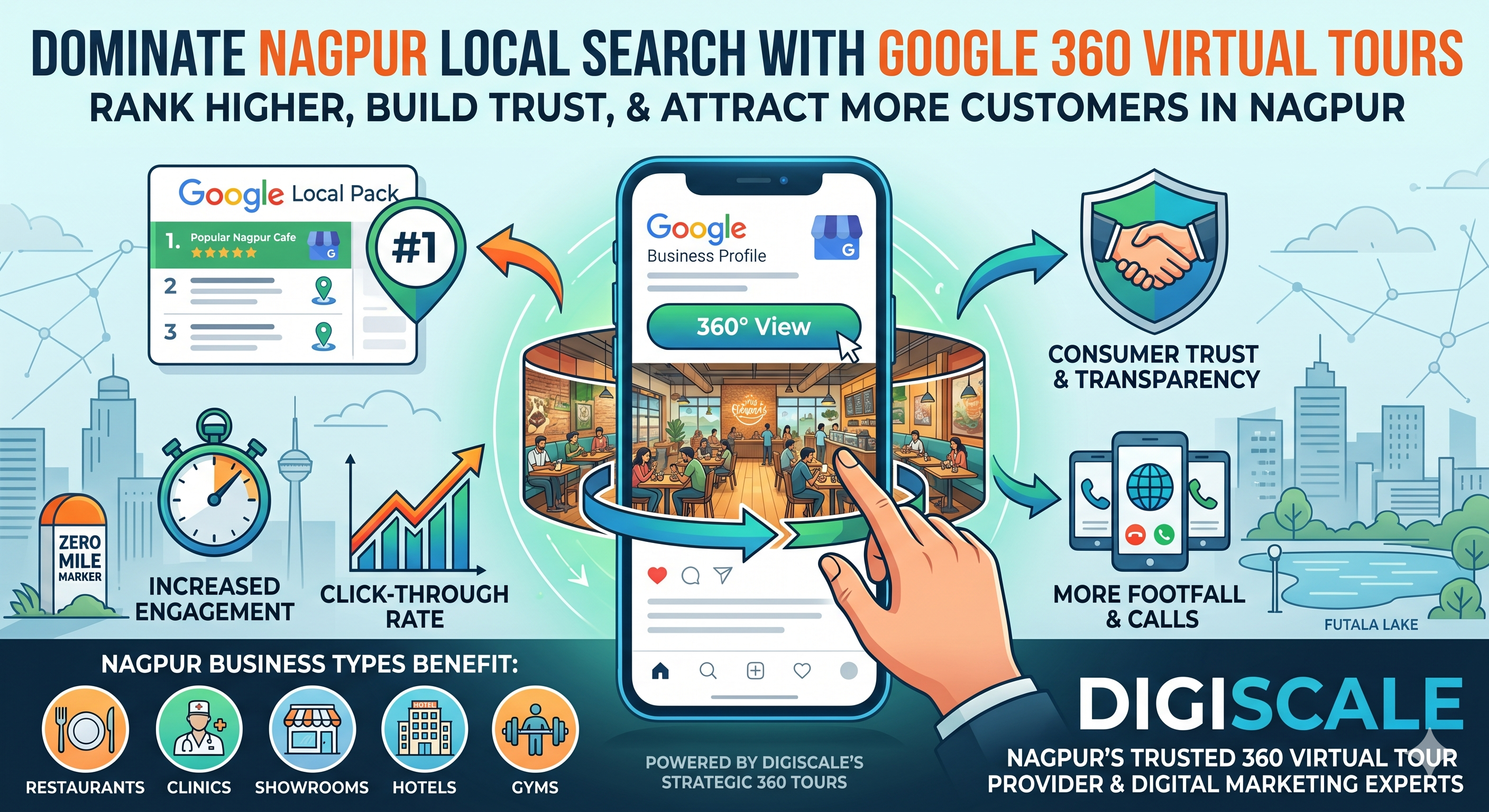
Your Google 360 Virtual Tour improves your Google Business Profile engagement signals, which improves your local search ranking, which drives more visitors to your listing, who then find your Instagram link and follow you, who then see your content and develop desire and trust, who then search for you on Google again when they are ready to act, and convert because your listing is complete and compelling.
Your Instagram content drives people to search for your business on Google. Your Google listing converts them. Your 360 virtual tour removes the last hesitation before they visit or enquire. Your WhatsApp integration captures the initial contact. Your review request sequence converts satisfied customers into Google reviewers that strengthen your listing for the next cycle.
This is the integrated system that Digiscale builds for clients in Nagpur and across India. Not individual channels managed separately, but a coordinated digital presence where every element multiplies the impact of every other element.
Measure What Matters and Ignore What Does Not
Every digital marketing channel produces metrics. Most of them are not worth your attention.
Ignore Instagram follower count, Facebook page likes, website total sessions, and ad impressions. These are activity metrics. They measure effort and exposure, not outcomes.
Measure Google Business Profile direction requests, website enquiry form submissions, WhatsApp enquiry volume, Google ranking positions for your target keywords, cost per lead from paid campaigns, and reviews generated per month. These are outcome metrics. They measure whether your digital marketing is actually producing business results.
Review these metrics monthly. Look for improvement trends over 3-month windows rather than reacting to individual weekly fluctuations. Make strategy adjustments based on what the data shows, not based on what feels right or what your competitor appears to be doing.
Frequently Asked Questions
How much should an Indian business budget for digital marketing in 2026?
A practical starting point is 5 to 8 percent of target monthly revenue. A business targeting Rs 3 lakh in monthly revenue should budget Rs 15,000 to Rs 24,000 per month for digital marketing. Adjust as results justify.